
Thursday, January 2, 2020

Sunday, January 1, 2017
Happy New Year!

Happy New Year from around the Pacific! May the year 2017 bring you many blessings filled with much love, joy, peace, and happiness!
HAPPY NEW YEAR! - English
Biba Añu Nuebu! – Chamorro
Feliz Año Nuevo! – Spanish
Peren En Parakapw! – Pohnpeian
Engan ke ya sasu! - Kosraean
Jeramman ilo iio in ekaal! – Marshallese
Pwapwan Ei Ier Mi Fo – Chuukese
Akemashite Omedetou Gozaimasu – Japanese
Ungil Beches Er Rak! – Palauan
Selsalan Ebéach e duw! – Yapese
Maligayang Bagong Taon – Tagalog
Hauoli Makahiki Hou – Hawaiian
Sehe Bokmanee Bateuseyo! – Korean
Gung Hay Fat Choy – Chinese
Cung-Chuc Tan-Xuan! – Vietnamese
Ameseighil ubwutiiwel Layúi Luugh me raagh féé! – Carolinian
Image source: howtolearn.com
Saturday, December 24, 2016
Merry Christmas from around the Pacific!

Merry Christmas from around the Pacific!
~Minagof Nochebuena ~ Felis Pasgua (Chamorro)
~Maligayan Pasko (Tagalog)
~Peren en Krismas (Pohnpeian)
~Monono ilo raaneoan Nejin (Marshallese)
~Falang e Baynag (Yapese)
~Tok Tapeng (Kosraean)
~Ungil Kurismas (Palauan)
~Pwapwan Kirisimas (Chuukese)
~Mele Kalikimaka (Hawaiian)
~Ameseighil ubwutiiwel Layi Luugh me raagh fee (Carolinian)
Friday, January 1, 2016
Happy New Year from around the Pacific!
Happy New Year from around the Pacific! May the year 2016 bring you many blessings filled with much love, joy, peace, and happiness!
HAPPY NEW YEAR! - English
Biba Añu Nuebu! – Chamorro
Feliz Año Nuevo! – Spanish
Peren En Parakapw! – Pohnpeian
Engan ke ya sasu! - Kosraean
Jeramman ilo iio in ekaal! – Marshallese
Pwapwan Ei Ier Mi Fo – Chuukese
Akemashite Omedetou Gozaimasu – Japanese
Ungil Beches Er Rak! – Palauan
Selsalan Ebéach e duw! – Yapese
Maligayang Bagong Taon – Tagalog
Hauoli Makahiki Hou – Hawaiian
Sehe Bokmanee Bateuseyo! – Korean
Gung Hay Fat Choy – Chinese
Cung-Chuc Tan-Xuan! – Vietnamese
Ameseighil ubwutiiwel Layúi Luugh me raagh féé! – Carolinian
Image source: howtolearn.com
Saturday, April 11, 2015
Great Math Websites
1- Aplus Math, URL: http://www.aplusmath.com/

Aplus Math provides Interactive math resources for teachers, parents, and students featuring free math worksheets, math games, math flashcards, and more.
2- Math TV, URL: http://www.mathtv.com/

Math TV is a platform that features a wide range of math videos covering a plethora of mathematical concepts. These videos are browsable via topic or by textbook.
3- AAA Math, URL: http://www.321know.com/

AAA Math offers thousands of arithmetic lessons from kindergarten through eight grade. Unlimited practice is also available on each topic which allows thorough mastery of the concepts.
4- Math's Fun, URL: http://www.mathsisfun.com/index.htm

This philosophy behind this website is to make math learning fun and enjoyable. It features a myriad of lessons and activities provided by teachers and math community from all around the world.
5- Math Central, URL: http://mathcentral.uregina.ca/index.php

Math Central is an Internet service for mathematics students and teachers. This site is maintained by faculty and students in Mathematics and Statistics and Mathematics Education at the University of Regina in Canada.
6- Ten Marks, URL: http://www.tenmarks.com/

TenMarks provides students with access to hints and video lessons on every problem, so if they can't recall something, or didn't quite get the topic when it was covered in class, they can quickly review the content, and move forward.
7- Maths Frame, URL: http://mathsframe.co.uk/

Mathsframe has more than 170 free interactive maths games. All resources are designed, by an experienced KS2 teacher, to help children to visualise numbers, patterns and numerical relationships and to develop their mathematical thinking. New games are added most weeks
8- SMILE, URL: http://mypages.iit.edu/~smile/index.html

The SMILE program was designed to enhance the elementary and high school learning of Science and Mathematics through the use of the phenomenological approach.
9- The Math Forum, URL: http://mathforum.org/

This is a community of teachers, mathematicians, researchers, students, and parents using the power of the Web to learn math and improve math education. The forum offers a wealth of problems and puzzles; online mentoring; research; team problem solving; collaborations; and professional development. Students have fun and learn a lot. Educators share ideas and acquire new skills.
10- Simpsons math

The Simpsonsmath contains over a hundred instances of mathematics ranging from arithmetic to geometry to calculus, many designed to expose and poke fun at innumeracy.
11- SuperKids

SuperKids lets you create your own Math drills. Simply select the type of problem, the maximum and minimum numbers to be used in the problems, then click on the button! A worksheet will be created to your specifications, ready to be printed for use.
12- Math Words

This is an interactive math dictionary with enough math words, math terms, math formulas, pictures, diagrams, tables, and examples to satisfy your inner math geek.
13- Math Guide

MATHguide offers a variety of mathematics lessons. Numerous lessons in algebra, geometry, and pre-calculus are available. One can also utilize an assessment resource, called quizmasters.
14- Math League

Mathleague.org offers a number of services focused on enhancing the quality and quantity of competitive mathematical opportunities available to students everywhere. We offer a variety of programs for students in grades 3-12.
15- Math Drills

Math-Drills has thousands of Free Math Worksheets for teachers and parents on a variety of math topics.
16- Math Goodies

Math Goodies is your free math help portal featuring interactive lessons, worksheets, and homework help.
17- Math Aids

Math-Aids is a free resource for teachers, parents, students, and home schoolers. The math worksheets are randomly and dynamically generated by our math worksheet generators. This allows you to make an unlimited number of printable math worksheets to your specifications instantly
18- Math Basics

Math Basics offers help with basic math like subtraction, multiplication, division, fractions, times tables and percents. It provides math tutorials and learning interactives to make learning math easier, and allow you to practice basic math skills at your own level and pace.
19- Get The Math

Get the Math is about algebra in the real world. See how professionals use math in music, fashion, videogames, restaurants, basketball, and special effects.
20- Absurd Math

Absurd Math is an interactive mathematical problem solving game series. The player proceeds on missions in a strange world where the ultimate power consists of mathematical skill and knowledge.
Source: http://www.educatorstechnology.com
Aplus Math provides Interactive math resources for teachers, parents, and students featuring free math worksheets, math games, math flashcards, and more.
2- Math TV, URL: http://www.mathtv.com/
Math TV is a platform that features a wide range of math videos covering a plethora of mathematical concepts. These videos are browsable via topic or by textbook.
3- AAA Math, URL: http://www.321know.com/
AAA Math offers thousands of arithmetic lessons from kindergarten through eight grade. Unlimited practice is also available on each topic which allows thorough mastery of the concepts.
4- Math's Fun, URL: http://www.mathsisfun.com/index.htm
This philosophy behind this website is to make math learning fun and enjoyable. It features a myriad of lessons and activities provided by teachers and math community from all around the world.
5- Math Central, URL: http://mathcentral.uregina.ca/index.php
Math Central is an Internet service for mathematics students and teachers. This site is maintained by faculty and students in Mathematics and Statistics and Mathematics Education at the University of Regina in Canada.
6- Ten Marks, URL: http://www.tenmarks.com/
TenMarks provides students with access to hints and video lessons on every problem, so if they can't recall something, or didn't quite get the topic when it was covered in class, they can quickly review the content, and move forward.
7- Maths Frame, URL: http://mathsframe.co.uk/
Mathsframe has more than 170 free interactive maths games. All resources are designed, by an experienced KS2 teacher, to help children to visualise numbers, patterns and numerical relationships and to develop their mathematical thinking. New games are added most weeks
8- SMILE, URL: http://mypages.iit.edu/~smile/index.html
The SMILE program was designed to enhance the elementary and high school learning of Science and Mathematics through the use of the phenomenological approach.
9- The Math Forum, URL: http://mathforum.org/
This is a community of teachers, mathematicians, researchers, students, and parents using the power of the Web to learn math and improve math education. The forum offers a wealth of problems and puzzles; online mentoring; research; team problem solving; collaborations; and professional development. Students have fun and learn a lot. Educators share ideas and acquire new skills.
10- Simpsons math
The Simpsonsmath contains over a hundred instances of mathematics ranging from arithmetic to geometry to calculus, many designed to expose and poke fun at innumeracy.
11- SuperKids
SuperKids lets you create your own Math drills. Simply select the type of problem, the maximum and minimum numbers to be used in the problems, then click on the button! A worksheet will be created to your specifications, ready to be printed for use.
12- Math Words
This is an interactive math dictionary with enough math words, math terms, math formulas, pictures, diagrams, tables, and examples to satisfy your inner math geek.
13- Math Guide
MATHguide offers a variety of mathematics lessons. Numerous lessons in algebra, geometry, and pre-calculus are available. One can also utilize an assessment resource, called quizmasters.
14- Math League
Mathleague.org offers a number of services focused on enhancing the quality and quantity of competitive mathematical opportunities available to students everywhere. We offer a variety of programs for students in grades 3-12.
15- Math Drills
Math-Drills has thousands of Free Math Worksheets for teachers and parents on a variety of math topics.
16- Math Goodies
Math Goodies is your free math help portal featuring interactive lessons, worksheets, and homework help.
17- Math Aids
Math-Aids is a free resource for teachers, parents, students, and home schoolers. The math worksheets are randomly and dynamically generated by our math worksheet generators. This allows you to make an unlimited number of printable math worksheets to your specifications instantly
18- Math Basics
Math Basics offers help with basic math like subtraction, multiplication, division, fractions, times tables and percents. It provides math tutorials and learning interactives to make learning math easier, and allow you to practice basic math skills at your own level and pace.
19- Get The Math
Get the Math is about algebra in the real world. See how professionals use math in music, fashion, videogames, restaurants, basketball, and special effects.
20- Absurd Math
Absurd Math is an interactive mathematical problem solving game series. The player proceeds on missions in a strange world where the ultimate power consists of mathematical skill and knowledge.
Source: http://www.educatorstechnology.com
Friday, January 2, 2015
Happy New Year!
Happy New Year from around the Pacific! May the year 2015 bring you many blessings filled with much love, joy, peace, and happiness!
HAPPY NEW YEAR! - English
Biba Añu Nuebu! – Chamorro
Feliz Año Nuevo! – Spanish
Engan ke ya sasu! - Kosraean
Gung Hay Fat Choy – Chinese
Ungil Beches Er Rak! – Palauan
Selsalan Ebéach e duw! – Yapese
Peren En Parakapw! – Pohnpeian
Hauoli Makahiki Hou – Hawaiian
Pwapwan Ei Ier Mi Fo – Chuukese
Sehe Bokmanee Bateuseyo! – Korean
Maligayang Bagong Taon – Tagalog
Cung-Chuc Tan-Xuan! – Vietnamese
Jeramman ilo iio in ekaal! – Marshallese
Akemashite Omedetou Gozaimasu – Japanese
Ameseighil ubwutiiwel Layúi Luugh me raagh féé! – Carolinian
Image source: howtolearn.com
Saturday, April 12, 2014
Math Quote/Proverb for the Times

"A journey of a thousand miles begins with a single step."
-Lao-Tzu
Friday, December 27, 2013
HAPPY NEW YEAR!

Feliz Ano Nuevo (Spanish)
Parakapw Mwahu (Pohnpei)
Ungil Becheserrak (Palau)
Akemashite Omedeto Gozaimasu (Japanese)
Hau'oli Makahiki Hou (Hawaiian)
Sut dal kum mum (Korean)
Gung Hay Fat Choy (Chinese)
Chúc Mung Nam Moi (Vietnamese)
May the year 2014 bring you abundant blessings filled with much love, joy, peace, and happiness!
Tuesday, December 24, 2013
Merry Christmas from around the Pacific!
 Merry Christmas from around the Pacific!
~Felis Pasgua (Chamorro)
~Maligayan Pasko (Tagalog)
~Peren en Krismas (Pohnpeian)
~Monono ilo raaneoan Nejin (Marshallese)
~Falang e Baynag (Yapese)
~Tok Tapeng (Kosraean)
~Ungil Kurismas (Palauan)
~Pwapwan Kirisimas (Chuukese)
~Mele Kalikimaka (Hawaiian)
~Ameseighil ubwutiiwel Layi Luugh me raagh fee (Carolinian)
Sunday, October 6, 2013
Math Classroom Ideas

The following is a resourceful website on Math bulletin boards and classroom ideas: http://www.myclassroomideas.com/tag/math/ Enjoy!
Saturday, October 20, 2012
UOG Culture and Learning Forum
The University of Guam's Enrollment & Student Services in collaboration with the School of Education and Human Resources Office held a meaningful
Culture & Learning Forum on October 19, 2012 with focus on "enriching and contextualizing teaching and learning in Pacific Island settings to improve achievement."
Participants were enlightened by various cultural speeches. Among a few of the highlights are the following:
"I have my own story, my own identity, and I need to accept that," said Dr. Isebong Asang, Palau Community College. Asang said that it's essential to have "knowledge, history and truth specific to Palau."
MESULANG, Dr. Asang, for the inspirational speech!
Dr. Nicholas Goetzfridt shared that we must genuinely focus on ethnomathematics, the language of numbers. He said that it "requires different people around the world, and in this case the Pacific, to adapt (relevant mathemathetics)."
Traditional ethnomathematics in the Pacific involve "navigators of the past, navigators of the present, and values to live on," Goetzfridt said. He stressed the traditional ideas of patterns and that if the indigenous mathematics is unable to be carried out, it is done through imperial colonial means.
Our traditional mathematics need to be preserved in education, because it is the essence of communal identity. In fact, the UH Project MACIMISE is doing research to recover mathematical ideas and curriculum ideas to be used in schools. This will allow us to imagine with purpose and resolve for our own ethnomathematical identity. To get an insight of the experience on one of the UH candidates' first phase of Project MACIMISE, visit http://projectmacimise-rivera.blogspot.com.
Dr. Frankie Santos Laanan, SOE Dean focused on "Sieving Through Asian and Pacific Island Data on Culture Variation and Achievement." He mentioned about the importance of STEM. He further shared videos and websites to provide explicit, yet meaningful visuals pertaining to its relevance. Check out Pathway2.stemdegree.org for more information.
Students in the videos shared powerful messages, such as the following: "I'm just as good as anyone else in college." Another student said, "I deserve to be here. I work just as hard as anyone here."
The CARE was also highlighted and its relevance in research regarding Asian Americans, risk factors of AAPI students, and other critical areas of research. Laanan also presented statistics and terminologies, such as MSI-Minority serving institution and AANAPSI-Asian Americans Native Americans Pacific Islanders.
Laanan expressed the need to expand knowledge, broaden awareness, and build institutional capacity. He shared DOE and UOG data to stress the critical needs. He mentioned that of the 31,000 students in DOE, there is a high ESL population. This entails that we are faced with the challenge to meet the unique needs of ELLs.
Unfortunately, Guam's latest SAT10 performance data shows low scores. This makes us question what's happening in these areas. "What are we going to do about it? How do we serve these students? What do we do to ensure that they understand?" Laanan asked.
He presented student demographics, trends, enrollment by ethnicity, gender, and status. He also shared that for the UOG English placement, 2/3 placed in developmental English (EN085 and EN100).
Laanan further shared retention and graduation tracking by program statistics, so that we can reflect and analyze the data. He then showed a Robert Feldman video that mentioned we need to take action, so that we don't endanger college student success. We need to provide opportunities for first year experiences before college students arrive on campus.
Dr. Michael Bevacqua focused on decolonization. He said that Guam is a colony and shared the expansive definition of decolonization. He stated that some people think that "if he (colonial power) ever leaves, all the things disappear" or "so long as the colonizer is in power, you are out of luck."
He questioned, "What is the role the university should take in regards to this situation?" He stressed that we should "look more regional for things," because it's important that we tap on our own resources that are within reach.
UOG President, Dr. Robert Underwood, also highlighted the importance of culture and education. "Education is one through which cultural knowledge is formulated," he said.
Underwood said, "It takes the strength of soul for a child to struggle, to travel, to succeed." He reminded participants to make a difference. "As you navigate, you must help them learn," he said.
Enjoy the following snapshots taken during the forum!
He highlighted culture as a process and that we must understand where those places are. Underwood further questioned, "What do we do about our students? What do we know about our students? Did we do anything about it (data performance)?"
Enjoy the following snapshots taken during the forum!
 |
| Dr. Robert Underwood, UOG President, says his speech on culture and learning. |
 |
| Dr. Isebong Asang, Palau Community College Professor, conducts her presentation titled, "Palauan Epistemology: Implications on Teaching & Learning." |
 |
| Dr. Frankie Santos Laanan, SOE Dean, conducts his presentation titled, "Sieving Through Asian and Pacific Island Data on Culture Variation and Achievement." |
 |
| Dr. Michael Lujan Bevacqua conducts his presentation titled, "Decolonization at the University of Guam." |
 |
| Larry Gamboa, UOG Chief Human Resources Officer, welcomes the participants of the Culture & Learning Forum. |
 |
| Dr. Nicholas Goetzfridt conducts his presentation titled, "Ethnomathematics in Micronesia." |
Friday, September 23, 2011
REL Northeast & Islands - Policy Challenges Webinar: Supporting the Transition to the Common Core State Standards in Mathematics
  |
Policy Challenges Webinar:
Supporting the Transition to the
Common Core State Standards in
Mathematics Webinar
Thursday, October 6, 20113:00–4:30 PM EDT

Sunday, August 14, 2011
MACIMISERS (Math and Culture in Micronesia - Integrating Societal Experiences) hold annual meeting in Pohnpei, FSM
 During the last two weeks in July, the 22 students of theMACIMISE project pursuing doctoral and master degrees held their annual meeting in Pohnpei, FSM. Taking in the local culture and sights, as well as the characteristic hospitality of the region, the MACIMISERS worked hard on the mission of the project that focuses on local practices, languages, and the preservation of mathematical ideas associated with these practices and languages. During the last two weeks in July, the 22 students of theMACIMISE project pursuing doctoral and master degrees held their annual meeting in Pohnpei, FSM. Taking in the local culture and sights, as well as the characteristic hospitality of the region, the MACIMISERS worked hard on the mission of the project that focuses on local practices, languages, and the preservation of mathematical ideas associated with these practices and languages. |
Sunday, July 31, 2011
Find pi with Your Windows 7 Calculator
What you need to do is to open the Windows 7 calculator by clicking Start and typing calc into the Search box. Hit Enter or click the calculator icon that appears in the list…

This will open up the calculator. Now, click on View and choose Scientific. Alternately, you can press Alt+2 to enable scientific mode.

Once in scientific mode, press the letter P on your keyboard.

Source: WorldStart's Computer Tips
Saturday, July 9, 2011
Regional Educational Laboratory Northeast and Islands - Monthly Digest: Math Instruction Resources

Monthly Digest — May/June 2011
The following content was added to the REL-NEI Website in May and June:
EDEVIDENCE ISSUES
Evidence-based resources from REL Northeast and Islands and the Institute of EducationSciences on Math Instruction. (June 16, 2011)
REFERENCE DESK DIGEST
What Does the Research Say About Addressing Challenges in Urban Inclusion Models? (May 13, 2011)
What Is the Impact of Middle School Math Teachers’ Educational Background on Student Achievement? (May 27, 2011)
What Does the Research Say About Regulations for Speech and Language Testing for English Language Learners? (June 10, 2011)
RSS FEED
Subscribe here to get the latest research findings, Reference Desk Digest, newsletter articles, multimedia, and news about upcoming events as they are posted on relnei.org.
For more information, e-mail Ashley Gaddis: agaddis@edc.org
The Regional Educational Laboratory Northeast and Islands (REL-NEI) is administered by Education Development Center, Inc. (EDC) in partnership with the American Institutes for Research (AIR) and WestEd’s Learning Innovations program. REL-NEI is one of 10 Regional Educational Laboratories funded by the Institute of Education Sciences at the U.S. Department of Education. REL-NEI provides rigorous research that is relevant to national education priorities, responsive to local needs, and usable for policy and practice. Visit www.relnei.org.
This project has been funded at least in part with federal funds from the U.S. Department of Education under Contract Number ED-06-CO-0025. The content of this publication does not necessarily reflect the views or policies of the U.S. Department of Education nor does mention of trade names, commercial products, or organizations imply endorsement by the U.S. Government.
Education Development Center, Inc. (EDC) is a global nonprofit organization that develops, delivers, and evaluates innovative programs to address some of the world’s most urgent challenges in education, health, and economic development. Visit www.edc.org.
Tuesday, June 15, 2010
Culminating Project MACIMISE, Guam Group Gathering at Westin Taste
 Pictured above (left side of table): Project MACIMISE participants Rosa Salas Palomo, Mary Mafnas, and Matilda Naputi Rivera. Right side: Dr. Donald "Don" Rubinstein, instructor; Bea Camacho, Project MACIMISE participant; and Pat Camacho.
Last night the Guam group involved in Project MACIMISE gathered together at Westin Taste to celebrate in person, instead of the usual online Elluminate sessions. The participants thanked Dr. Don Rubinstein for being an inspirational and culturally-responsive instructor, alongside, Sandy, Don, and Neil who were with us in spirit. The group also congratulated Bea Camacho for being selected for the Project MACIMISE indigenous UH Doctorate Program coordinated by UH and PREL. Congratulations, Bea!
Un Dangkulo Na Si Yu'os Ma'ase', Don, Sandy, Neil, Joe, and fellow Project MACIMISERS, for the wonderful indigenous experience we will always remember. Good luck, and we know that you will do great things for our children! BIBA PROJECT MACIMISE!
Friday, April 30, 2010
A Project MACIMISE Cake JUST FOR YOU!
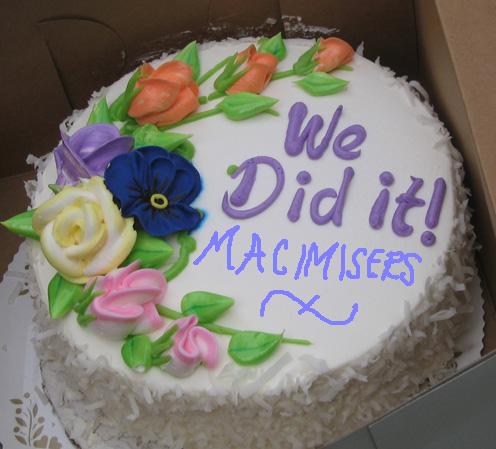
Dear Fellow MACIMISERS,
WE DID IT! We finished our presentation and submitted our final research paper! It has certainly been a labor of love for me, not only because I did much research involving the mathematics of coconut weaving, but also because I got to learn more about my Chamorro culture and spend more time with my Mom, who is also a coconut-leaf weaver. What was supposed to be only 20 pages ended up being 61 pages long!
In light of our accomplishment, I dedicate this special Project MACIMISE cake (please see image above), JUST FOR YOU -- ALL OF YOU! It has been a wonderful and challenging journey for all of us, and I hope to work closely with you for the years to come, so that we can ultimately make a difference in the mathematics skills of our island's children. KUDOS TO ALL OF YOU!
Wednesday, April 28, 2010
The Countdown Is Here!
5 4 3 2...........................1!
Buenas! Would you believe that the countdown is here already? We have gone through so much and have completed countless of hours and days of research, interviews, exploration of the crafts, etc. The time has come for us to gather all our knowledge on mathematics in an organized and meaningful fashion, so I encourage you to go full force and don't look back, because the countdown will go by so fast! 5, 4, 3, 2......1! Good luck my fellow MACIMISERS!
Presentation completed and good luck on finalizing your research paper!
YOU CAN DO IT!
Hafa Adai! I'm glad that I was able to complete my presentation titled, Using Coconut Weaving in Guam Classrooms to Improve the Mathematics Skills of Local Students. It was also wonderful to view and hear about the different indigenous cultural presentations that were shared tonight! Didn't you just love Rosa's singing of the CHamorita to end our night? I have learned from everyone of you, and I am grateful for the Project MACIMISE experience. Our children will be the ones to benefit from all the hard work we've put into our research.
Now that half of us have completed our presentations, it's now time to finalize our research paper! Remember to meet the deadline by Friday, April 30, 2010 by 5:00 p.m. I am confident that we can all do it! *Here's wishing all of you the BEST!*
Sunday, April 25, 2010
Draft #3 in Progress!
DRAFT #3
Hafa Adai! I have just received my second draft from Don, so the research isn’t over yet! I am now working on draft #3, and I'll be sure to add additional images he requested for each of the weaving crafts I listed in my research paper. The pandanus-leaf mat may be a bit challenging to provide visuals for, but I will certainly do my best, because I'm hitting for the "TARGET" in completing this valuable project. It has been a long journey for me, as I've immersed myself in the project, from interviewing, researching, learning the weaving craft, involving my students in the Chamorro artistry of weaving, completing drafts, and the list goes on. Nevertheless, all the hard work and diligence has enlightened me, as I've been able to connect with and learn more about my Chamorro culture, spend more time with my parents, and in particular, my mother, who is a coconut-leaf weaver and cancer survivor, and so much more! I truly hope to continue the Project MACIMISE journey for all 5 years, so that I can make a difference to ultimately increase the mathematics skills of our island's children. *Here's to the success of Project MACIMISE!*
Subscribe to:
Posts (Atom)
